
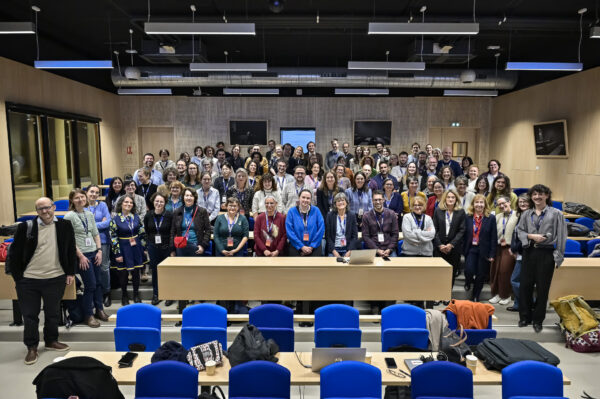
The fifth session of the HAL Partners’ Assembly took place on 12 and 13 November 2025 at the ENSSIB premises in Villeurbanne. This year’s event, a forum for exchange between HAL partners, welcomed nearly 140 participants.
As it has done every year since 2020, the HAL Partners’ Assembly convened for its fifth annual meeting. As in previous years, the 2025 session comprised two key events: an initial half-day institutional meeting devoted to reviewing the work carried out in 2025 and looking ahead to the coming year, followed by a day of thematic studies addressing current issues in research evaluation.
This article summarises the institutional day, which brought together the CCSD teams and Assembly members. It provided an opportunity to review HAL’s progress, as well as its past, current and future structural projects.
HAL in 2025: consolidation and influence
Nathalie Fargier, Director of the CCSD, opened the day by presenting the three main strategic priorities of HAL:
- strengthening its structuring role in the Open Science ecosystem,
- developing the platform’s uses through support and innovation,
- and ensuring its technical and financial sustainability.
With over 1.5 million full-text documents, 154 institutional portals, and over 100,000 active users, HAL is establishing itself as one of the world’s largest open archives, with increasing international recognition.
In 2025, HAL also obtained Core Trust Seal certification, attesting to the reliability and quality of its data management. This recognition has enabled several structural projects to be launched, particularly in the areas of licences and partnership agreements.
Finally, HAL’s integration into international networks such as COAR, SCOSS, OpenAir and EOSC consolidates its role in defining standards and defending an archive model based on interoperability, strengthening its position both nationally and internationally.
Functional innovations and review of the HALiance project
Yannick Barborini, the HAL Design and Development Manager, then presented the progress made on the HALiance project. Funded by the ANR until 2027, the project aims to modernise the technical base of HAL and enhance the user experience.
In 2025, the application was migrated to the Symfony framework, which improved its performance and accessibility. A notable innovation is the creation of links between publications and research data. To date, more than 11,000 new links have been established with datasets and software, harmonised according to the DataCite schema and distributed to partner repositories via the COAR Notify protocol.
Finally, from January 2026, the provision of reuse conditions will become mandatory for all full-text deposits. This addresses a major issue, as at the beginning of the year, more than 75% of files did not have them.
Session on services for researchers and institutions
The day continued with a session in which three users shared their experiences of using HAL services in different institutional contexts.
Feedback from a research unit
Françoise Acquier (documentalist at UGA) and Nicolas Tixier (architect and lecturer-researcher at UGA, as well as a HAL ambassador), both from the CRESSON laboratory at UGA, presented their open science strategy based on HAL. This approach is founded on three pillars: providing daily support to researchers for depositing and curating data; adopting internal regulations that make depositing in HAL mandatory; and integrating Open Science into research practices via complementary platforms such as Nakala, Canal U and Hypothèses.
HAL forms the backbone of researchers’ digital identities at CRESSON and acts as a living repository for scientific output, including retrospectively for this laboratory, which has been in existence for nearly 50 years.
Technical validation handled by the University of Toulon.
Yannick Mosset, the librarian and head of the Electronic Documentation and Research Support Department at the University of Toulon, presented feedback from the university, which has been responsible for the technical validation of its HAL portal since 2024. Led by the Joint Documentation Service (with two dedicated staff members), this initiative aimed to structure the services offered to researchers and speed up the processing of submissions. To date, the results demonstrate a sustainable workload and faster validation.
Hélène Bégnis (Head of the Support, Training and User Community Coordination Department at HAL) concluded the presentation by detailing the support offered by the CCSD to institutions wishing to take this step. This includes a one-hour scoping meeting to clarify issues, present volume indicators, and identify potential obstacles to implementation.
Feedback from a research community
Guillaume Routier (Senior Lecturer in Sociology at UFR STAPS, UCBL; researcher at L-VIS; and HAL Ambassador) presented the HAL STAPS community collection, supported by the Conference of STAPS Directors. In a young, multidisciplinary scientific field that is fragmented across numerous departments and laboratories, this initiative aims to increase the visibility, consistency, and academic legitimacy of STAPS publications.
With the backing of the laboratories, the project intends to bring the entire community together around a shared strategy for archiving and promoting research. Currently, 32 out of 35 STAPS laboratories are present on HAL, with the ambition of making the discipline one of the first to be fully represented on the platform.
CCSD actions and prospects for HAL portals
On the first day of the Assembly, Hélène Bégnis gave a presentation on the progress of work on technical validation. With 44 institutions involved, the CCSD is pursuing two major projects: overhauling training provision in this area, and creating a decision tree to harmonise validation practices. The recent appointment of a coordinator for the community of validators will facilitate the establishment of a network of practices that addresses the expressed needs of the field.
Laurent Courtaud, head of the Partnerships and Industries team at the CNRS, then presented the revised HAL portal agreement for the period 2026–2029. This aims to clarify the roles and commitments of the parties involved, particularly with regard to training and the responsibilities of institutions in deposit validation and GDPR compliance.
This Partners’ Meeting demonstrated the vitality of ongoing projects and the collective dynamic that continues to shape the HAL and open science ecosystem. It confirms the importance of regular dialogue between communities, institutions, and the CCSD, in order to support practices and anticipate future developments.