
Technical validation in HAL has become a strategic component in ensuring deposit quality, but it is still carried out under highly uneven conditions across institutions. A survey conducted in late 2025 by the CCSD among technical validators makes it possible to move beyond impressions and establish a solid diagnosis, based on a national questionnaire and semi-structured interviews.
The questionnaire, open from November 20 to December 19, 2025, collected 108 complete responses, out of 220 sent. In parallel, 10 semi-structured interviews were conducted with complementary profiles (CCSD staff and validators from different institutions).
What the survey tells: a critical role under pressure
The first key finding on the survey is that validators form a committed community, but one that is also diverse and relatively new. A significant share of respondents have only recently taken on this role, and most of them come from universities.
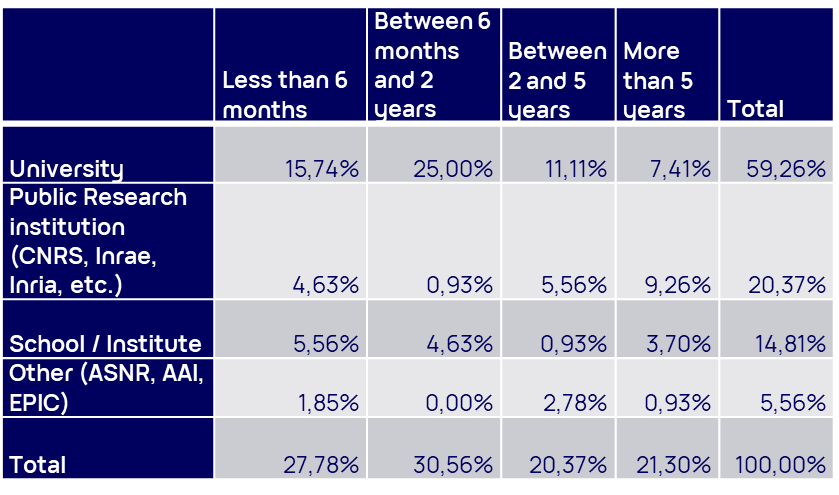
Distribution of validators by experience length and institution type
This first set of data shows that nearly 60% of respondents are university validators, and that 58% of validators have less than two years of experience.
The second key finding concerns validation workload. For most respondents, validation is a partial duty rather than a full-time position, and this workload must coexist with other responsibilities.
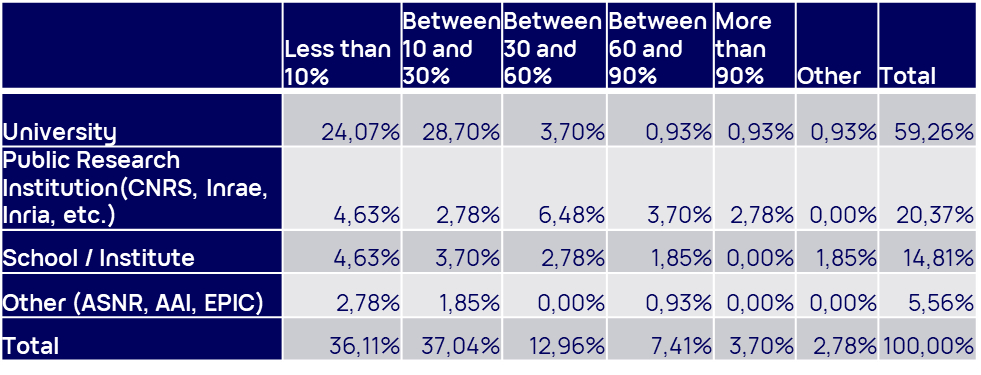
Validator’s weekly workload by institution type
This second set of data shows that for more than 70% of validators, the weekly workload represented by validation does not exceed 30%.
This gap is central: responsibility is high, while resources are fragmented. As a result, practices are often developed « as they go », with local solutions that may be effective but are difficult to scale or transfer widely.
Three recurring pressure points
The survey highlights recurring difficulties, regardless of institution type:
- Lack of time, which limits the ability to handle complex cases calmly and thoroughly,
- Recommendations that are sometimes difficult to implement depending on local contexts,
- A lack of shared tools, which leads each institution to recreate resources already developed elsewhere.
Taken together, these are not isolated operational issues, they point to a structural coordination problem.
The hidden issue: national consistency in decision-making
The interviews reveal a very concrete concern: when rules are interpreted differently depending on context, decisions can vary from one institution to another. For depositors, this reduces clarity; for validators, it undermines the security of their decisions. In other words, this is not only an organizational issue. It directly affects the consistency of service delivery at the national level.
Why a national network is the most practical response
The survey results do not call for another administrative layer. They call for a useful professional infrastructure centered on two major functions:
- A living reference framework, not a static manual: practical fact sheets, typical cases, decision trees, and response templates, with the aim of aligning practices on a shared, updatable foundation.
- Peer-to-peer facilitation: targeted webinars, feedback sessions, dans collective case resolution. Regular spaces are needed where people can learn quickly, together, from real problems.
What to remember
The survey is pretty straightforward: validators do not lack skill or commitment. What they lack is a sufficiently structured shared framework that can turn scattered efforts into collective strength. A national network of validators is therefore not a “comfort” option, but a pragmatic response to:
- Reduce heterogeneity in practices,
- Secure decision-making,
- Improve clarity for depositors,
- Sustainably strengthen the quality of technical validation of HAL deposits.