
The 3rd Global Summit Diamond Open Access
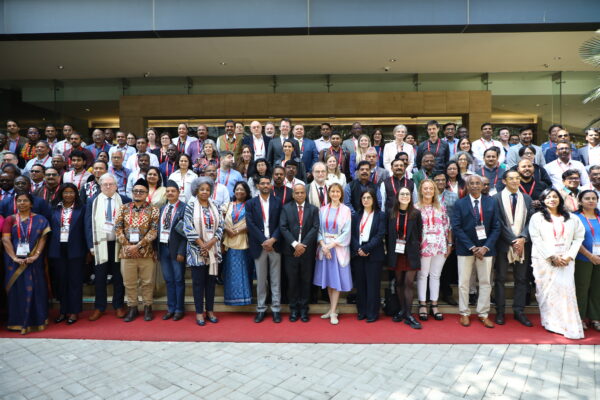
From February 2nd to 6th, 2026, India hosted the 3rd Global Summit Diamond Open Access, an international event dedicated to diamond open access scientific publishing. Held in Bangalore, this third summit brought together between 150 to 200 participants from across all continents.
The theme of this edition, Collaboration for Equitable Digital Infrastructures and Knowledge Commons in Agriculture and Broader Scientific Research Systems emphasized the construction of shared digital infrastructures and the development of knowledge commons, particularly in the fields of agriculture and broader scientific research systems. More information is available on the event’s official website: https://www.diamondoasummit.org/
For the third time, the Episciences platform took part in the summit. This year, Raphaël Tournoy, Episciences Platform Manager, and Delphine Crubellier, International development and promotion officer for Episciences, represented the platform and the CCSD.
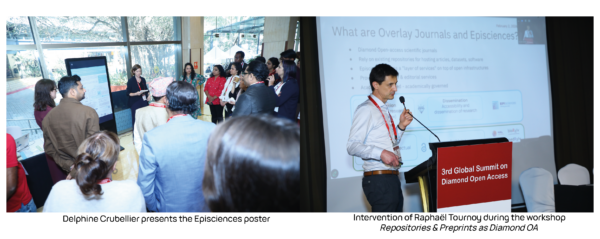
During the week, Raphaël Tournoy spoke at a workshop titled “Repositories & Preprints as Diamond OA” to present the diamond publication model promoted by Episciences. This model is based on an overlay approach, relying on preprints deposited in open repositories and reviewed by the editorial boards of the journals hosted on the platform. A poster presenting Episciences was also displayed by Delphine Crubellier, providing an opportunity to discuss with various open science stakeholders the importance of collaborating with committed researchers in order to increase the visibility of journals, improve their discoverability, and strengthen their ability to attract high-quality publications.
One of the summit’s key issues focused on linguistic diversity in scholarly publishing. How can the diamond model help promote scientific output in different languages? Thematic working groups were organized, including one dedicated to the French-speaking world, bringing together representatives from Quebec, Belgium, and France.
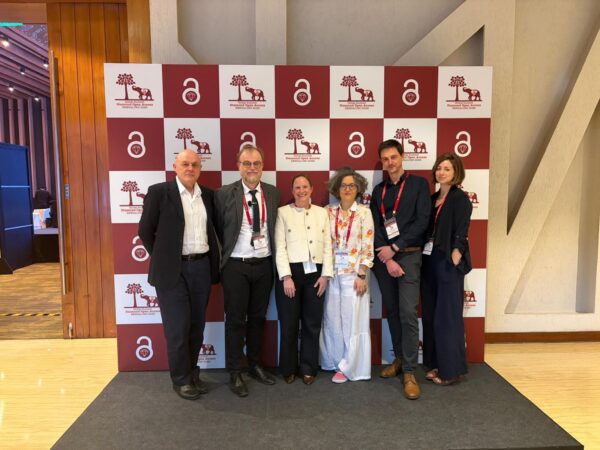
Part of the working group on the French-speaking world: Johan Rooryck, Marin Dacos, Zoé Ancion, Laurence El-Khouri, Raphaël Tournoy et Delphine Crubellier.
The decision to hold the summit in different countries reflects a strong commitment: to better understand the local contexts in which open-access initiatives are emerging and to enable scientific communities from different regions of the world to take part. Travelling allows for a deeper understanding of the realities, constraints and priorities specific to each region. While the values promoted by diamond open-access publishing are widely shared among participants, the solutions implemented vary depending on the context. These international meetings are therefore essential for exchanging perspectives and sharing experiences.
Meeting with C.S. Aravinda, editor of a mathematics journal
The trip to India also provided an opportunity to meet C. S. Aravinda, director of publication of the mathematics journal Hardy–Ramanujan Journal (HRJ), which is hosted on Episciences. Founded in 1978, the journal joined the platform in 2014 and is the oldest journal hosted on the platform.
This meeting helped strengthen ties with the journal, which is already highly engaged with developments in open science. Discussions focused both on the journal’s future development and on the broader context of research in India and internationally.
Raphaël Tournoy and Delphine Crubellier presented forthcoming developments to the journal’s website interfaces on the Episciences platform, opening a discussion on the needs of editorial teams and the expectations of scientific communities.
Beyond the technical aspects, this meeting helped maintain a direct relationship with the journal in order to better understand its institutional and scientific contexts and to further consolidate the Episciences journal network.