
In the international landscape of open archives—dominated by locally deployed platforms or large thematic repositories—HAL occupies a unique position. Its model is based on a national, shared infrastructure that serves all academic institutions while allowing each to have dedicated, customizable spaces called “portals. In celebration of HAL’s 25th anniversary, let’s take a look at the history of portal creation.
A HAL portal is a web service specifically designed for institutions (research organizations, universities, university communities, grandes écoles, etc.). It enables them to manage, archive, disseminate, and promote the publications, software, and scientific data of their researchers.
A single deposit feeds several institutional portals
In practice, a portal is a subset of HAL. Whenever an author is affiliated with a laboratory or team under the supervision of an institution, their publications are automatically displayed in that institution’s portal. For example, a researcher’s publications from Aix-Marseille Université will appear in the university’s portal. If they work in a laboratory with multiple supervising bodies—such as the CNRS, as is the case with UMRs—the publication will also appear in the CNRS portal.
A Brief History of Portal Creation
The portal functionality has existed since 2003. In celebration of HAL’s 25th anniversary, let’s look back at the timeline of portal creations:
Inria paved the way for resource sharing in 2005 by becoming the first institution to launch its portal. Inserm, ENS-Lyon and Jean Monnet University in Saint-Étienne followed suit the following year. An inter-institutional memorandum of understanding signed in 2006 established HAL as a shared platform and generated real momentum: by 2007, 11 portals had been created. Since then, the number of new portals has varied between 5 and 13 depending on the year. The year 2014 was an exception, with only two new portals: the announcement that a new version of HAL would go live by the end of the year caused a marked slowdown, as institutions preferred to wait before committing.
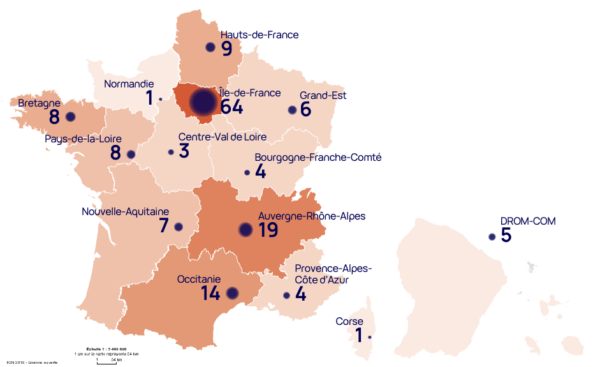
The growth in the number of portals in recent years has coincided with the institutionalisation of open science. By 2025, 153 institutional portals had been established, covering virtually all French universities and research organisations.
The Many Advantages of the Shared Model
A shared infrastructure offers numerous benefits, both technical and organizational:
- Cost Efficiency: sharing a single infrastructure eliminates redundant investments in hardware and software. Institutional open archives rely on the same technological foundation, maintained and developed by the CCSD.
- Technical Consistency: a single software solution and unified data model eliminates compatibility issues between systems. Users benefit from a consistent technical environment, simplifying maintenance and tool evolution.
- Data Standardization: uniform data entry practices—with mandatory fields (author affiliations, licenses, etc.) and shared reference lists (authors, research structures, ANR projects, etc.)—ensure data homogeneity. This standardization improves comparability, reduces errors, and enhances overall data quality.
- Community Collaboration: a shared infrastructure fosters a wider community (researchers, support staff, institutions, funders, etc.), where contributions benefit everyone. For example: a deposit, correction, or enrichment by one user automatically updates the CVs of co-authors, publications appear in ANR portals or laboratory collections. This collective effort accelerates progress, promotes best practices, and maximizes the impact of available resources.
In summary, a shared infrastructure combines technical efficiency, economies of scale, and strengthened collaboration, providing an optimal framework for all stakeholders. This is what HAL offers at the national level, making it unique in the international open archive landscape.